Study global development online, flexibly.
Global development remains one of the most influential and contested ideas in international relations.
Join us online to examine global development, from its emergence as a project after the Second World War to the challenges it faces in the 21st century.
In this Masters-level online short course, you’ll:
- learn about global development’s origins and institutional frameworks
- assess its impacts, and how it’s shaped the modern world
- consider whether traditional development models are still fit for purpose today.
With escalating climate change, geopolitical tensions, and greater representation of Indigenous and marginalised voices on the world stage – is there still a shared understanding of what development means, or is it time for a fresh approach?
What makes our Global Development course different?
This course offers a distinctive blend of historical depth, critical analysis, and real‑world relevance that few others match.
Gain a broader perspective
Examining a global range of viewpoints, including Indigenous and Global South perspectives, you’ll gain a deeper understanding of development and its uneven impacts on marginalised communities.
See development differently
Rather than simply studying development as policy, you’ll explore its history, future, and full context as a contested political, cultural, and environmental process.
Build critical analytical skills
You’ll develop the analytical skills to evaluate competing ideas, question dominant narratives, and imagine alternative futures with confidence.
Who can join this online Global Development course?
This distance-learning course is designed for learners interested in understanding how development has been imagined, implemented, and contested over time.
The course is particularly well suited to you if you have an interest in, or background in:
- international relations
- politics
- sociology
- geography
- development
- environmental studies
- anthropology, or
- related disciplines.
More broadly, it’s suitable for anyone curious about whether traditional development approaches remain fit for purpose in a rapidly changing world.

Build credits towards a Masters degree
This online course is part of online:
You can use the credits you earn with this short course towards this MSc qualification.
What you’ll study
By the end of this global development course, you’ll be able to...
-
Demonstrate your understanding of the historical and political emergence of differing development theories.
-
Assess the legal, cultural, and economic impact of specific global development institutions on human populations and communities.
-
Evaluate the criticisms of global development theories and institutions with regard to specific groups.
-
Explore the potential impact of emerging global development models on specific groups.
In this course, you’ll assess the project of ‘Global Development’, begun in the wake of the Second World War to bring “scientific advances and industrial progress to underdeveloped nations.” (Harry S. Truman)
How successful have these initiatives been?
And is there still consensus on, or a place for, a single understanding of “development”?
With expert guidance, you’ll critically examine these questions and how global development has been imagined, implemented, and contested over time.
You’ll cover the following topics:
The history of global development theory and practice
You’ll examine:
- early religious and imperial ideas of “improvement”
- racialised and colonial projects of population management
- post-WWII development as state‑led economic and social transformation
- critiques that expose development’s cultural, political, and economic biases.
The changing institutions of global development
You’ll examine:
- how Cold War geopolitics shaped the International Monetary Fund (IMF), World Bank, World Trade Organisation (WTO), General Agreement on Tariffs and Trade (GATT), and rival socialist and post colonial blocs
- whether development has ever been a neutral endeavour rather than a deeply political one.
Addressing global inequalities
You’ll explore how globalisation:
- intensified both growth and inequality
- deepened North-South divides
- marginalised Indigenous communities, and
- prompted new global goals, such as the United Nations (UN) Millennium Development Goals.
Global development futures
You’ll examine how a range of factors are reshaping what “development” can mean in a climate-altered world.
You’ll analyse the impact of climate change, the UN’s Sustainable Development Goals, and emerging multipolar powers, for example, BRICS (Brazil, Russia, India, China, and South Africa), China’s Belt and Road initiative, and the Northern Sea Route.
Content advice
This course may occasionally cover themes that some students may find upsetting. We are an inclusive university that takes the pastoral care of our students seriously. The classroom will be made a safe space to engage sensitively with this content. Confidential and impartial support is also available from the Student Advice and Support Office.
Choose the University of Aberdeen for online global development courses

Fits around full-time work
This online course fits around work, with flexible hours and 24/7 study access.

Over 530 years of excellence
Study with the fifth-oldest university in the English-speaking world, founded in 1495.

You’re in expert hands
We’ve been delivering online and distance learning for decades.
How you’ll study
Online learning
This distance-learning global development course is delivered flexibly, 100% online.
You can learn with us anywhere in the world, no student visa required, and manage your study hours to suit you.
Your teaching
This course is taught at Masters level.
Teaching is delivered through MyAberdeen, our online Virtual Learning Environment (VLE). It holds all the materials, tools, and support you’ll need in your studies. Take a look around MyAberdeen.
You can access your learning materials on computer, smartphone, and laptop, 24 hours a day. You’ll find a range of resources available, including:
- videos
- pre-recorded video lectures
- a live online session
- reading materials
- discussion boards with your tutors and fellow students
- the online resources of our award-winning Sir Duncan Rice Library.
Live online session
In this course, you’ll have contact with your tutors via discussion boards and a live online drop-in session.
In the live session, you can ask questions and discuss your course material. Live session attendance is optional.
Your tutors
This course is delivered by the School of Social Science.
You’ll learn from an internationally experienced team of academics with strong research credentials in this field.
There are no formal exams for this course.
You’ll be assessed online via your coursework.
Assessment methods
- Your contributions to online discussion boards (worth 50% of your final course grade).
- A 2,000-word reflective report (worth 50%).
The course totals approximately 300 hours of study and assessment time.
That’s around 25 – 30 hours per week.
This is an indicative guide to the time required for a typical student at this level to achieve the learning outcomes.
This includes time for independent study, as well as teaching and assessments.
You can largely set your own study hours each week to cover the materials. MyAberdeen is available 24/7, so you can log in and study when it suits you.
Activities at fixed times
There may be some activities scheduled at a fixed time, such as online meetings with your tutor or assessments with deadlines.
But otherwise, you can access and work through the course at your convenience.
Our first-class support structure will ensure that you aren’t alone in your studies.
You’ll have contact with your coordinator via email, MyAberdeen, and Microsoft Teams.
You can use social media and discussion boards to chat with your fellow students too.
We provide a wide range of services to support you in your studies:
- Careers and Employability Service
- Disability support
- IT support
- Library support
- Student Support Service – help with finances, wellbeing and non-academic issues
- Student Learning Service – support with academic skills, writing and maths, with advice sessions and workshops available
- Aberdeen University Students’ Association (AUSA) – run by students for students
- Toolkit – a guide to apps and free training that can make your study life easier
Wherever you are in the world, you’ll feel part of our very special Aberdeen learning community.
See a more in-depth guide to all of our online support services.
Your course coordinator
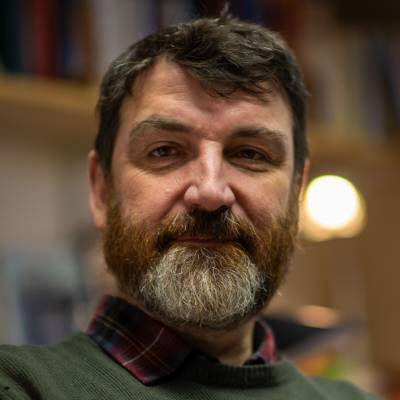
Professor Martin Mills
Martin is Chair in Anthropology at the University of Aberdeen and is Director of the Scottish Centre for Himalayan Research.
His research interests include anthropology, Asian studies, Buddhism, climate change, and politics.
Martin has carried out extensive fieldwork in Tibet, Ladakh, China, Northern India, and Scotland.
View Martin’s profileWhere this will take you
Towards a Masters
You’ll earn 30 credits at Masters level (SCQF Level 11) with this course. You can use these credits towards our online:

Masters in International Relations
Develop a deep, critical understanding of contemporary global challenges, power structures, and the evolving nature of international politics.
View MSc International Relations
Free career support
Access our free careers service while you study.
- 1:1 appointments
- CV checks
- Interview prep
- Job opportunities
Careers with Global Development
This course is designed to help you progress within or towards careers in:
- global development
- international policy
- social justice
- government departments
- think tanks
- environmental and climate-focused organisations
- Indigenous rights advocacy, and
- global governance bodies.
Possible roles
This could prepare you for roles including:
- policy analyst
- development practitioner
- NGO programme officer
- humanitarian coordinator
- researcher
- journalist, or
- advisor in international organisations.
Career benefits
This course offers substantial career benefits.
You’ll gain critical analytical skills, historical and institutional understanding, and the ability to evaluate development initiatives from multiple perspectives.
All of these skills are essential for roles that require navigating complex global challenges and designing equitable, sustainable policy solutions.
Continuing Professional Development (CPD)
Your employer or professional institute may recognise this course for CPD hours. Talk to your employer or institute to find out more.
Choose the University of Aberdeen for flexible online short courses

Learn anywhere
On smartphone, desktop and laptop, with no need for a student visa.

Flexible
Flexible hours and 24/7 access, so you can study when it suits you.

20% alumni discount
University of Aberdeen alumni get 20% off fees for this online course.
Entry requirements
Entry requirements
We welcome students from all over the world.
This course has no formal entry requirements. You do not need to provide proof of your qualifications.
But you do need to check the entry guidance above to understand the level of teaching delivered, to decide if this course is right for you.
If you do not have qualifications from the UK, check the equivalent teaching level for your country.
Visa requirements
You do not need a student visa to study online with us.
English language requirements
Teaching is delivered in English.
You do not have to provide proof of your English language skills to join this course. But we want to make sure that you can use English well enough to study successfully.
Recommended level of English
This course uses our Postgraduate Higher level of English language proficiency.
These are our Postgraduate Higher requirements, and these are minimum scores.
IELTS Academic, IELTS UKVI Academic, or IELTS Online (not IELTS Indicator or IELTS General Training)
- 6.5 overall
- 5.5 for listening and speaking
- 6.0 for reading and writing
TOEFL iBT or TOEFL iBT Home Edition
- 90 overall
- 17 for listening
- 21 for reading
- 20 for speaking
- 21 for writing
- TOEFL DI code is 0818
Cambridge English: B2 First, C1 Advanced, or C2 Proficiency
- 176 overall
- 162 for listening and speaking
- 169 for reading and writing
LanguageCert Academic / LanguageCert Academic SELT
- 70 overall
- 60 for listening and speaking
- 65 for reading and writing
Oxford ELLT Digital – English Language Level Test Online
- 7.0 overall
- 5.0 for listening and speaking
- 6.0 for reading and writing
PTE Academic (online test not accepted)
- 62 overall
- 59 for listening, reading, speaking and writing
Skills for English: SELT
- B2 pass with merit
Duolingo – tests taken from 1 July 2024 onward
- 120 overall
- 95 for listening and speaking
- 105 for reading and writing
University of Aberdeen English Pre-sessional Programme (PSE)
- Pass
- Valid for one year. Refresher can be offered if out of date
Pre-sessional academic English preparation programmes undertaken at other UK universities
- Pass at an equivalent of 6.5 (C1)
- B2 in all four skills
- Certification must be within one year prior to the start of your course
For more information about language qualifications see our English Language Requirements page.
When you study with us, you can expect a first-class support structure so that you’re never alone in your studies.
But learning online does mean you have to motivate yourself and manage your own time.
Your most important commitment will be time – the time to work through, reflect on and understand your teaching materials.
Before you start a course that involves a high degree of independent study, we recommend looking at the time you will be able to devote to your studies each week:
- Be realistic
- Create a weekly schedule as a guide
If you have any questions about studying online, get in touch with our friendly team. We’re here to help.
You will need access to:
A computer (PC, laptop or Mac) with an up-to-date operating system
Most teaching materials are smartphone- and tablet-friendly. But we recommend a proper laptop or desktop for completing assignments comfortably.
Reliable internet access
We recommend:
- a wired connection
- a minimum download speed of 2 Mbps so you can take part fully in live sessions.
Speakers or headphones
- We recommend a headset with built-in microphone and earphones if you’re likely to study in an environment with background noise.
- A webcam is optional, but you may like to use one for some interactive sessions.
Software
We’ll give you access to Microsoft 365 applications. This means you can use online versions of Microsoft Word, Excel, PowerPoint, and OneDrive and install these programs on up to five personal devices.
If your course requires specialist software, we’ll provide you with access to this and a licence that lasts throughout your studies.
See our detailed IT requirements for more information.
Fee payment
Your course fee needs to be paid in full before you start your course.
We accept payment via Visa Debit, Visa Credit and Mastercard.
Ways to save
You may be able to get help funding this course via:
- discounts – if any discounts are available for this course, they’ll appear in the section below
- employer sponsorship – we accept full and partial fee payments from sponsors.
Find out more about funding options.
Student card
All our students are entitled to a University of Aberdeen student card. This gives you access to a range of student discounts around the city and online.
Optional book purchases
Access to all the essential books and resources you need are included in your tuition fee. They’ll be made available to you online and you do not have to buy your own copies.
We also provide optional recommended reading lists. Many of these resources are available electronically through our library, although purchases may be required if you wish to read the full list.
Printing
You may want to set aside a small budget for printing, depending on how you like to work.
This course has no formal entry requirements. You decide if it’s suitable for you.
The course is delivered at Masters level. At this level, for this course, you’d usually have at least:
- a 2:2 UK honours degree (or equivalent), or
- relevant experience that supports this level of study.
Your right to cancel starts on the date of payment of the tuition fees for this course and expires 15 days after the start date of this course.
The University of Aberdeen is not responsible for resolving any issues concerning software, hardware, or internet, in relation to your personal computer and this course.
Please read our full terms and conditions.